Follow me on Twitter RSS FEED

Sumpah Pemuda

Posted in
The Youth Pledge (Indonesian: Sumpah Pemuda), was a declaration made on 28 October 1928 by young Indonesian nationalists at a conference in the then-Dutch East Indies. They proclaimed three ideals, one motherland, one nation and one language.

Background

The first Indonesian youth congress was held in Batavia, capital of the then-Dutch East Indies in 1926, but produced no formal decisions but did promote the idea of a united Indonesia. In October 1928, the second Indonesian youth congress was held at three different locations. In the first session, the hope was expressed that the congress would inspire the feeling of unity. The second session saw discussions about educational issues. In the third and final session, held at Jalan Kramat Raya No, 126, on October 28 participants heard the future Indonesian national anthem Indonesia Raya by Wage Rudolf Supratman. The congress closed with a reading of the youth pledge.

The pledge

In Indonesian, with the original spelling, the pledge reads:
Pertama
Kami poetera dan poeteri Indonesia, mengakoe bertoempah darah jang satoe, tanah air Indonesia.
Kedoea
Kami poetera dan poeteri Indonesia, mengakoe berbangsa jang satoe, bangsa Indonesia.
Ketiga
Kami poetera dan poeteri Indonesia, mendjoendjoeng bahasa persatoean, bahasa Indonesia.
In English:
Firstly
We the sons and daughters of Indonesia, acknowledge one motherland, Indonesia.
Secondly
We the sons and daughters of Indonesia, acknowledge one nation, the nation of Indonesia.
Thirdly
We the sons and daughters of Indonesia, respect the language of unity, Indonesian.

BUKITTINGGI

Posted in
Bukittinggi (Indonesian for "high hill") is one of the larger cities in West Sumatra, Indonesia, with a population of over 91,000 people and an area of 25.24 km². It is situated in the Minangkabau highlands, 90 km by road from the West Sumatran capital city of Padang. It is located at 0°18′20″S 100°22′9″E / 0.30556°S 100.36917°E / -0.30556; 100.36917, near the volcanoes Mount Singgalang (inactive) and Mount Marapi (still active). At 930 m above sea level, the city has a cool climate with temperatures between 16.1°-24.9°C.

History


Fort de Kock in 1826
The city has its origins in five villages which served as the basis for a marketplace.
The city was known as Fort de Kock during colonial times in reference to the Dutch outpost established here in 1825 during the Padri War. The fort was founded by Captain Bauer at the top of Jirek hill and later named after the then Lieutenant Governor-General of the Dutch East Indies, Hendrik Merkus de Kock. The first road connecting the region with the west coast was built between 1833 and 1841 via the Anai Gorge, easing troop movements, cutting the costs of transportation and providing an economic stimulus for the agricultural economy. In 1856 a teacher-training college (Kweekschool) was founded in the city, the first in Sumatra, as part of a policy to provide educational opportunities to the indigenous population. A rail line connecting the city with Payakumbuh and Padang was constructed between 1891 and 1894.
During the Japanese occupation of Indonesia in World War II, the city was the headquarters for the Japanese 25th Army, the force which occupied Sumatra. The headquarters was moved to the city in April 1943 from Singapore, and remained until the Japanese surrender in August 1945.

Mosque in central Bukittinggi
During the Indonesian National Revolution, the city was the headquarters for the Emergency Government of the Republic of Indonesia (PDRI) from December 19, 1948 to July 13, 1949. During the second 'Police Action' Dutch forces invaded and occupied the city on December 22, 1948, having earlier bombed it in preparation. The city was surrendered to Republican officials in December 1949 after the Dutch government recognized Indonesian sovereignty.
The city was officially renamed Bukittinggi in 1949, replacing its colonial name. From 1950 until 1957, Bukittinggi was the capital city of a province called Central Sumatra, which encompassed West Sumatra, Riau and Jambi. In February 1958, during a revolt in Sumatra against the Indonesian government, rebels proclaimed the Revolutionary Government of the Republic of Indonesia (PRRI) in Bukittinggi. The Indonesian government had recaptured the town by May the same year.
A group of Muslim men had planned to bomb a cafe in the city frequented by foreign tourists in October 2007, but the plot was aborted due to the risk of killing Muslim individuals in the vicinity. Since 2008 the city administration has banned Valentine's Day and New Year's celebrations as they consider them not in line with Minangkabau traditions or Islam, and can lead to "immoral acts" such as young couples hugging and kissing.

Administration

Bukittinggi is divided in 3 subdistricts (kecamatan), which are further divided into 5 villages (nagari) and 24 kelurahan. The subdistricts are:
Guguk Panjang, Mandiangin Koto Selayan, and Aur Birugo Tigo Baleh.

Transportation

Bukittinggi is connected to Padang by road, though a dysfunctional railway line also exists. For inner-city transport, Bukittinggi employs a public transportation system known as Mersi (Merapi Singgalang) and IKABE that connect locations within the city. The city also still preserves the traditional horse-cart widely known in the area as Bendi, although the use is limited and more popular to be used as vehicle for tourist, both domestic and foreign.

Tourism

It is a city popular with tourists due to the climate and central location. Attractions within the city include:

Sianok Canyon
  • Ngarai Sianok (Sianok Canyon)
  • Lobang Jepang (Japanese Caves) - a network of underground bunkers & tunnels built by the Japanese during World War II
  • Jam Gadang - a large clock tower built by the Dutch in 1926.
  • Pasar Atas and Pasar Bawah - traditional markets in downtown.
  • Taman Bundo Kanduang park. The park includes a replica Rumah Gadang (literally: big house, with the distinctive Minangkabau roof architecture) used as a museum of Minangkabau culture, and a zoo. The Dutch hilltop outpost Fort de Kock is connected to the zoo by the Limpapeh pedestrian overpass.
  • Museum Rumah Kelahiran Bung Hatta (Museum of Bung Hatta Birthplace) - the house where Indonesian founding father Mohammad Hatta was born, now a museum.

Introducing Bukittinggi

Posted in
     Welcome to a cool, lush landscape where fertility comes from volcanic destruction. Off in the distance are the blue circumcised mountains – the Merapi, Singgalang and the more distant Sago – that periodically belch out the earth’s interior fury. A crown of puffy white clouds hides their naked tips, and at their feet unfold terraced rice fields made so fertile by the once toxic emissions that seasons don’t matter. Sitting at 930m above sea level, Bukittinggi is a busy market town halfway between the heavens and the rice paddies, with spectacular views of both. The town’s alternate name, Tri Arga, refers to the three majestic mountains that dictate the region’s fortunes.
     Bukittinggi was once a well-carved niche in the Southeast Asia trail but now only sees a trickle of travellers headed for hikes to the nearby volcanoes, rafflesia sanctuary or for culture tours into the Minangkabau heartland.
     During the Padri Wars (1821–37), a civil war between the local chiefs and Islamic reformists, Bukittinggi was a Dutch stronghold (the Dutch sided with the chiefs in this conflict). After independence it was also here that Sumatran rebels declared an independent government in 1958 – one of a long list of separatist attempts in the archipelago.

Topologi Jaringan

Posted in
Topologi Jaringan

Topologi suatu jaringan didasarkan pada cara penghubung sejumlah node atau sentral
dalam membentuk suatu sistem jaringan. Topologi jaringan yang umum dipakai
adalah : Mess, Bintang (Star), Bus, Tree, dan Cincin (Ring).

1. Topologi Jaringan Mesh
Topologi jaringan ini menerapkan hubungan antar sentral secara penuh. Jumlah
saluran harus disediakan untuk membentuk jaringan Mesh adalah jumlah sentral
dikurangi 1 (n-1, n = jumlah sentral). Tingkat kerumitan jaringan sebanding dengan
meningkatnya jumlah sentral yang terpasang. Dengan demikian disamping kurangekonomis juga relatif mahal dalam pengoperasiannya.

2. Topologi Jaringan Bintang (Star)
Dalam topologi jaringan bintang, salah satu sentral dibuat sebagai sentral pusat. Bila
dibandingkan dengan sistem mesh, sistem ini mempunyai tingkat kerumitan jaringan
yang lebih sederhana sehingga sistem menjadi lebih ekonomis, tetapi beban yang
dipikul sentral pusat cukup berat. Dengan demikian kemungkinan tingkat kerusakan
atau gangguan dari sentral ini lebih besar.


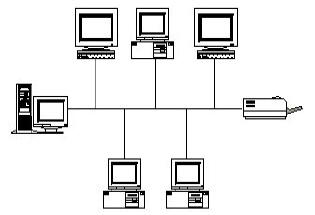
3. Topologi Jaringan Bus
Pada topologi ini semua sentral dihubungkan secara langsung pada medium transmisi
dengan konfigurasi yang disebut Bus. Transmisi sinyal dari suatu sentral tidak
dialirkan secara bersamaan dalam dua arah. Hal ini berbeda sekali dengan yang terjadi
pada topologi jaringan mesh atau bintang, yang pada kedua sistem tersebut dapat
dilakukan komunikasi atau interkoneksi antar sentral secara bersamaan. topologi
jaringan bus tidak umum digunakan untuk interkoneksi antar sentral, tetapi biasanya
digunakan pada sistem jaringan komputer.


4. Topologi Jaringan Pohon (Tree)
Topologi jaringan ini disebut juga sebagai topologi jaringan bertingkat. Topologi ini
biasanya digunakan untuk interkoneksi antar sentral dengan hirarki yang berbeda.
Untuk hirarki yang lebih rendah digambarkan pada lokasi yang rendah dan semakin
keatas mempunyai hirarki semakin tinggi. Topologi jaringan jenis ini cocok
digunakan pada sistem jaringan komputer .


5. Topologi Jaringan Cincin (Ring)
Untuk membentuk jaringan cincin, setiap sentral harus dihubungkan seri satu dengan
yang lain dan hubungan ini akan membentuk loop tertutup. Dalam sistem ini setiap
sentral harus dirancang agar dapat berinteraksi dengan sentral yang berdekatan
maupun berjauhan. Dengan demikian kemampuan melakukan switching ke berbagai
arah sentral.


Keuntungan dari topologi jaringan ini antara lain : tingkat kerumitan jaringan rendah
(sederhana), juga bila ada gangguan atau kerusakan pada suatu sentral maka aliran
trafik dapat dilewatkan pada arah lain dalam sistem.Yang paling banyak digunakan
dalam jaringan komputer adalah jaringan bertipe bus dan pohon (tree), hal ini karena
alasan kerumitan, kemudahan instalasi dan pemeliharaan serta harga yang harus
dibayar. Tapi hanya jaringan bertipe pohon (tree) saja yang diakui kehandalannya
karena putusnya salah satu kabel pada client, tidak akan mempengaruhi hubungan
client yang lain.